
Plan your AI compute network topology as three tiers: scale-up inside the rack, scale-out between racks, and scale-across between sites. Size GPUs, switches, and fiber cabling for your expected workload traffic. This approach keeps any tier from becoming a bottleneck or running oversubscribed. Then use UpScale’s SkyD to automatically compute topologies, fiber distances, and hardware placement.
I am Frederic Van Haren, CTO of HighFens. I attended Tech Field Day AI Infrastructure Field Day 6 as a delegate. UpScale presented there, and two of its sessions stood out and built on each other.
Everything you need to know about AI Compute Network Topology
UpScale gave us an intriguing tour of how data center networking has evolved.
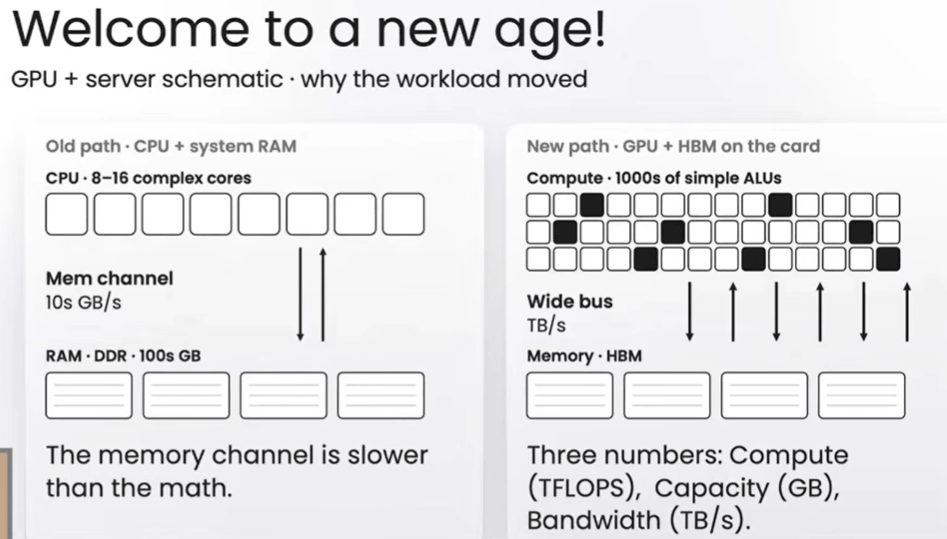
Traditional environments emphasized north-south traffic and three-tier designs. Then virtualization and distributed applications shifted traffic east-west, which encouraged leaf-spine and Clos architectures. Now GPU clusters raise the stakes. Models run across many GPUs, and those GPUs must exchange partial results quickly.
The presentation breaks backend networking into three layers:
- Scale-up connects GPUs within a rack with very low latency.
- Scale-out connects racks through Ethernet or InfiniBand fabrics.
- Scale-across links data centers into a larger AI factory.
Separate front-end and storage networks serve users, deliver model weights, store checkpoints, and handle KV-cache traffic.
Inference makes these relationships especially important.
During prefill, the system processes a prompt and builds the KV cache. During decode, it generates tokens while accessing that cache. As models and context windows grow, cache movement and storage access add more traffic.
Therefore, all three network domains must meet their own performance and resiliency requirements.
I enjoyed Aninda Chatterjee’s presentation and highly recommend it as a tutorial for anyone who wants to understand AI compute network topology. It gives technology leaders a practical mental model for the architecture decisions behind AI performance and scale.
Watch Aninda’s full presentation here.
Take the guesswork out of the design of your AI Network
Designing large-scale networks is complex and error-prone. These networks span hundreds of GPUs, many switches, and thousands of fiber runs. Usually, problems surface only when teams assemble the network in the data center. Missing or incorrect cables, or a design flaw, can delay schedules.
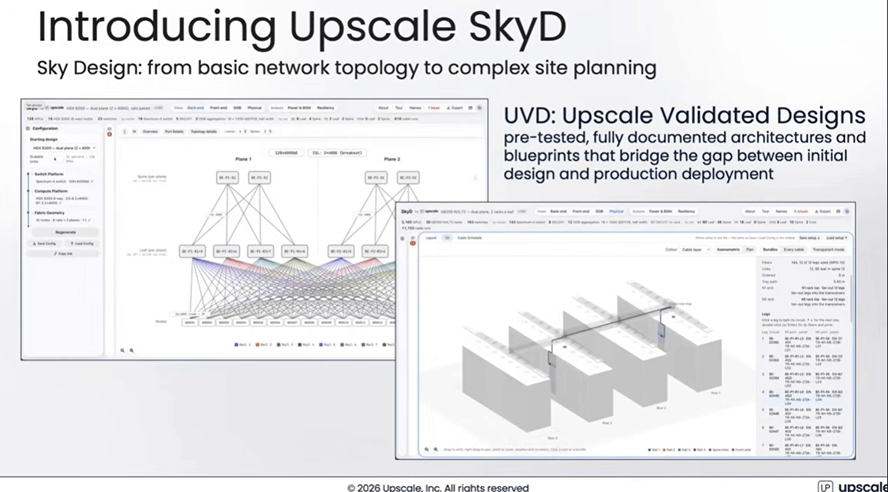
Sky Design from UpScale is a browser-based tool that supports Validated Designs. It automatically computes optimal topologies, fiber distances, and hardware placements for large-scale AI deployments.
It also sizes the backend, frontend, and management networks. In addition, it draws floor maps and rack layouts and shortens fiber runs.
Furthermore, it maps how switch, optic, or fiber failures affect bandwidth. As a result, architects no longer have to guess the requirements for an AI compute network. The tool analyzes, calculates, and reviews everything before deployment, which avoids costly design errors.
Follow along as Nicolas Fevrier reviews SkyD’s capabilities here.
Takeaway
Faster GPUs or extra switches cannot fix AI network complexity after performance problems appear. Instead, you need workload-aware architecture and validation of both topology and physical deployment.
UpScale’s presentations offer a practical path. First, understand how AI traffic moves. Then use tools such as SkyD to turn that understanding into a design your team can review and implement.
If your team is planning an AI cluster and wants an expert design review, contact HighFens today.